

Key Takeaways
A control module fault is not always a failed module. Careful testing can separate damaged electronics from a weak battery, poor ground, faulty sensor, or communication problem.
- Read the complete fault history rather than relying on one dashboard warning.
- Check power, grounds, connectors, wiring, and network communication before replacing a module.
- Choose repair, reset, replacement, or coding based on the actual failure and vehicle configuration.
- Treat airbag and other safety-system work as specialist repairs requiring strict testing.
- Ask about testing, turnaround, stored data, coding, and warranty coverage before authorizing work.
Understanding MG control modules and common failures
Modern vehicles rely on several electronic units that share information constantly. A fault in one can create warnings in other systems, so the visible symptom is not always located where the problem began. MG control module repair therefore starts with the vehicle as a connected system, not just a single removable box.
The right repair also depends on the module’s role, its physical condition, and whether it can be returned to the vehicle with the correct configuration. Water, unstable voltage, and damaged wiring can all produce symptoms that look like an internal electronic failure.
What a control module does in an MG vehicle
A control module receives signals, processes programmed instructions, and sends commands or data to other vehicle systems. Depending on its role, it may be involved in braking assistance, restraint systems, lighting, body functions, engine management, or communication between networks. It is best understood as one part of a wider chain rather than an isolated computer.
When a module stops communicating, the vehicle may record faults in several other units. That is why replacing the first component named by a scan tool can be an expensive guess instead of a diagnosis.
Common module types, including airbag, ABS, and body control units
Airbag or SRS units monitor impact sensors and restraint-system circuits. ABS and stability-control units process wheel-speed and related chassis information, while body control units may manage functions such as lighting, locking, windows, and other electrical features. The exact layout varies by model, year, and equipment level.
For a useful model-specific example, an ABS control module guide discusses warning lights, traction-control loss, speedometer symptoms, moisture, corrosion, sensors, wiring, and CAN-bus faults. Those possibilities illustrate why a module should not be condemned before the surrounding circuit has been checked.
Symptoms of a failing or corrupted module
Symptoms can be intermittent or constant. Warning lamps, missing vehicle functions, communication errors, repeated fuse failures, a no-start condition, or several unrelated-looking fault codes may all justify further investigation. A module that works briefly and then drops offline can be harder to diagnose than one that has failed completely.
Record when the symptom appears, whether it follows rain or a flat battery, and whether other systems fail at the same time. That history can reveal a shared power or network problem and gives the technician a better starting point.
Why water damage, voltage issues, and wiring faults matter
Moisture can corrode pins and circuit-board tracks, while a weak battery or charging fault can expose sensitive electronics to abnormal operating conditions. Loose grounds and damaged network wiring can interrupt communication without damaging the module itself. Physical inspection is therefore as important as electronic testing.
A useful general rule is find the root cause first. Cleaning or replacing a unit while leaving a leaking seal, poor ground, or unstable charging system untouched often leads to a repeat failure. Broader maintenance guidance, such as this masonry repair guide, also shows why controlling water entry matters when protecting vehicle electronics.
Diagnosing an MG control module fault
Diagnosis should move from simple checks to specialized testing. The aim is to prove whether the module has power, ground, and communication, then determine whether its internal circuits respond correctly. A scan report is evidence, not a final verdict.
The vehicle’s age, model, and system architecture affect which tests are possible. A careful technician preserves the original codes and freeze-frame information before clearing anything, since erased evidence can make an intermittent fault more difficult to reproduce.

Reading diagnostic trouble codes accurately
A diagnostic trouble code identifies a condition detected by a system; it does not always identify the failed part. Codes should be read from all relevant modules, with their status, frequency, and supporting data recorded. Communication codes are especially valuable when several modules report that messages are missing or invalid.
After repairs, codes should be cleared only when appropriate, followed by a controlled test drive and another scan. A code that returns immediately means something different from a historic code that stays absent after the underlying issue is corrected.
Distinguishing a module failure from a sensor or wiring problem
A sensor may send implausible data, a connector may have high resistance, or a broken wire may interrupt a circuit. The module can then report a fault even though its own processor and memory are healthy. Comparing live data with physical measurements helps separate these possibilities.
Do not use a warning lamp alone as proof of module failure. The same symptom can come from a damaged harness, poor connector fit, blown fuse, or a network fault elsewhere in the vehicle.
Checking battery voltage, grounds, connectors, and communication networks
Power and ground checks should be made under realistic load, not only with a meter resting across the battery. Inspect connectors for moisture, pushed-back terminals, discoloration, and strain. Network wiring also needs checks for continuity, shorts, termination, and evidence of interference or physical damage.
A simple inspection sequence keeps the work focused:
- Confirm battery condition and charging-system output.
- Verify module fuses, power feeds, and grounds under load.
- Inspect connectors, harness routes, and signs of moisture.
- Compare network communication with the vehicle’s fault history.
This sequence does not replace model-specific procedures, but it prevents many unnecessary module replacements. It also helps document why a repair or replacement is being recommended.
When specialist diagnostic equipment is required
Basic code readers may not access every module, configuration function, or manufacturer-specific test. Specialist equipment can be needed for security access, coding, actuator tests, software procedures, and network diagnosis. Airbag, ABS, and high-voltage systems deserve particular caution.
A technician should be able to explain which test equipment is being used and what result would confirm the diagnosis. If the fault involves a vehicle dynamics network, background on an invalid-data communication code can help explain why network testing matters, although the vehicle’s own data must guide the repair.
Choosing between repair, reset, replacement, and coding
These four options are not interchangeable. Repair addresses an internal hardware fault, reset removes eligible stored information, replacement substitutes another unit, and coding or programming makes a unit match the vehicle. Choosing correctly avoids paying for a procedure that cannot solve the original problem.
The decision should account for safety, part compatibility, software state, physical damage, and the reason the fault occurred. A written diagnosis is useful before authorizing work, especially when a replacement unit costs substantially more than testing.
When an electronic module can be repaired
Repair may be practical when the circuit board has localized corrosion, a failed component, damaged solder joints, or a power-supply fault that can be identified and tested. The unit must still have serviceable core hardware and recoverable data. A reputable service should test the module before and after the work.
External damage must also be addressed. If a connector is burned or a housing has allowed water inside, repairing the board alone may not produce a lasting result.
Situations that require crash-data or fault-code resetting
Some airbag modules retain crash information after a deployment event, while other faults may leave stored records that require a proper reset procedure after the underlying issue is fixed. Resetting data does not replace deployed airbags, pretensioners, damaged sensors, or wiring.
For a documented service example, 10843299/01 MG Airbag Module Repair and Reset is specifically described as clearing stored crash data from that module. Another source describes an MG ALL 10429167-01 reset service for clearing crash data from a specified SRS unit. These are part-specific services, not a general answer for every restraint-system fault.
When replacement is safer than module repair
Replacement may be the responsible option when a unit has severe board damage, missing or unrecoverable data, repeated internal failure, or a safety-critical defect that cannot be validated confidently. A used unit may also carry the wrong configuration or history, so physical similarity is not enough.
The replacement must be checked against the vehicle and its software requirements. A part that communicates but is not correctly configured can still produce faults or disable functions.
Why programming, coding, and vehicle configuration matter
Many modules need vehicle-specific configuration after installation. This can include identification data, equipment settings, network relationships, calibration, or security pairing. Without that step, a repaired or replacement unit may be electrically sound but unable to operate correctly in the vehicle.
Ask whether coding is included in the quoted work and whether the technician can verify the final configuration. The repair is not complete merely because the warning light goes out temporarily.
The MG control module repair process
A professional repair process is a chain of inspection, measurement, controlled repair, and verification. It should preserve relevant data where possible and record the condition in which the unit arrived. This approach is more reliable than replacing components based on appearance alone.
Turnaround depends on the fault, parts availability, testing requirements, and whether the vehicle or only the module is being handled. The workshop should explain what happens if the unit fails testing or reveals damage outside the original estimate.
Removing and inspecting the faulty unit
Removal begins with safe isolation of the vehicle and careful identification of the module and connectors. The technician should note part numbers, visible damage, moisture, contamination, and any signs of previous repair. Photographs and condition notes can prevent confusion when several similar units exist.
The surrounding installation is inspected too. A clean-looking module may have failed because of a leaking panel, a chafed harness, or a connector that is no longer holding its terminals securely.
Testing circuit boards, power supplies, and communication circuits
On the bench, the unit can be checked for power-supply behavior, short circuits, processor activity, memory access, and communication response. The exact test method depends on the design and the available technical information. A meaningful test reproduces the reported failure where possible rather than simply confirming that the board turns on.
Measurements should be compared with known-good behavior or documented specifications. This helps identify whether the fault is localized and repairable or whether the unit is too compromised to validate.
Repairing corrosion, damaged components, and solder faults
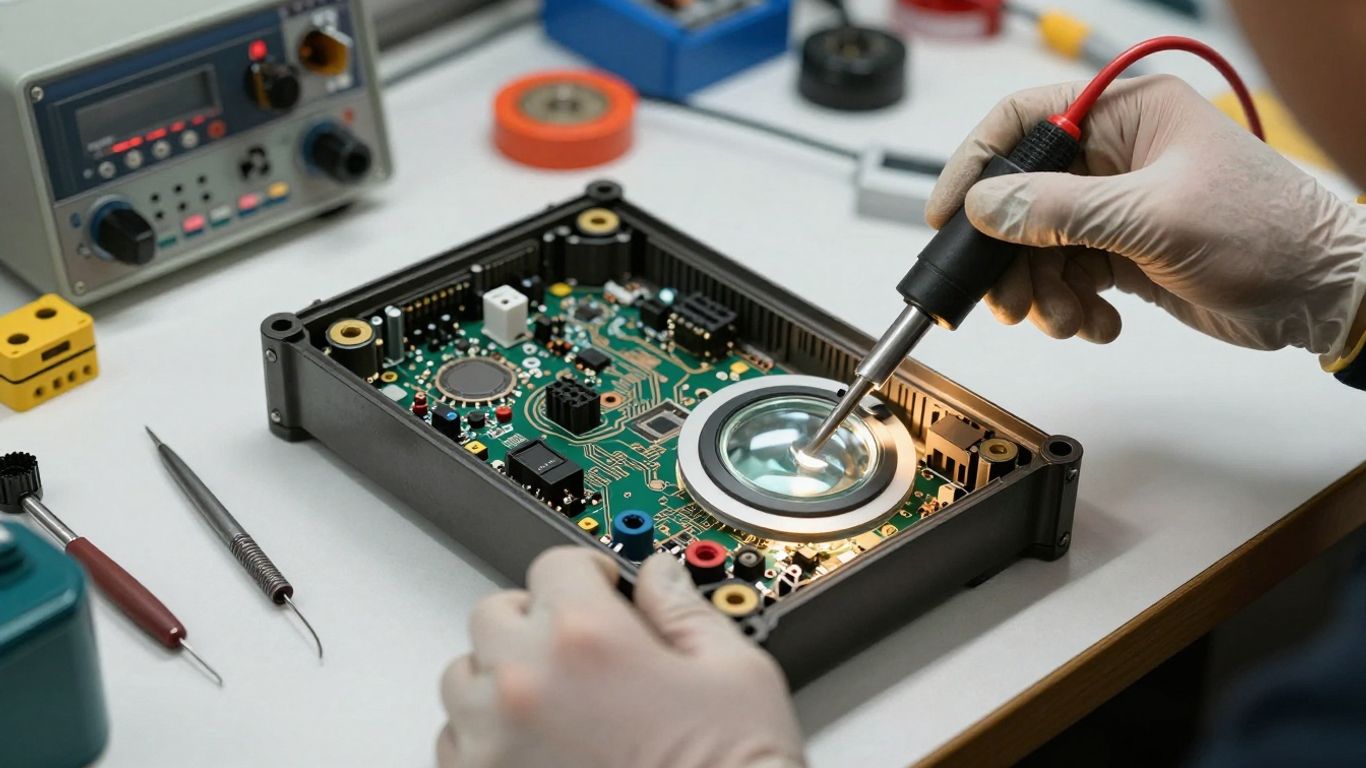
Repair work may include cleaning corrosion, replacing failed electronic components, restoring damaged tracks, and correcting cracked or contaminated solder joints. The technician must avoid removing more material than necessary and should inspect the repaired area under magnification.
The repaired board is then tested again, including the circuits that originally failed. Cosmetic cleaning alone is not a repair, and a component replacement without finding the cause of its failure can be short-lived.
Restoring software, configuration, or stored data
Some jobs require data recovery, configuration transfer, or an approved reset procedure. The original data should be handled carefully, since an incorrect file or incomplete write can make a usable module unusable. Security-related operations should be performed only with suitable equipment and authorization.
After bench work, the module may need vehicle-level coding and functional checks. A general circuit breaker repair guide makes a similar distinction between repair, reconditioning, and replacement; the same decision discipline is useful here, even though vehicle electronics require their own procedures.
Special considerations for airbag and safety modules
Safety modules deserve a higher standard of evidence because their failure can affect occupant protection. The warning lamp is only one part of the assessment. The complete restraint system, including related wiring and devices, must be checked before the vehicle is returned to normal use.
A reset can restore a module’s usable state in an eligible case, but it cannot undo physical damage or substitute for parts that deployed. Work should follow the vehicle’s service information and applicable safety procedures.
How crash data affects airbag module operation
After a collision or deployment event, an airbag module may store crash information and set a restraint-system fault. Depending on the unit and event, the stored data can prevent normal operation or keep the warning lamp illuminated. Clearing that information is only one step in restoring the system.
The technician must establish what happened, which devices deployed, and whether the module itself can be tested reliably. The event history should not be guessed from a single code.
Why airbag repairs require strict safety procedures
Airbags and pretensioners contain pyrotechnic devices and must be handled with the battery, connectors, and waiting periods specified by the manufacturer. Improvised probing or testing can create an avoidable risk. A specialist should use suitable restraint-system procedures and equipment.
The work area, packaging, transport, and storage also matter. A repair that ignores safe handling is not acceptable simply because the electronics appear functional.
Verifying pretensioners, airbags, and impact sensors
Every deployed or suspect restraint component should be identified and tested or replaced as required. Impact sensors, wiring, connector locks, seat connections, and pretensioners can all contribute to a persistent fault. The module should not be cleared while damaged parts remain in the system.
A complete inspection is particularly important after a collision because hidden harness damage may not be visible without careful access. The final scan should show that the restraint network is communicating normally.
Post-repair testing before returning the vehicle to the road
After installation, the technician should verify power, communication, warning-lamp behavior, diagnostic status, and the condition of the restraint components. A road test may be appropriate for related vehicle systems, provided it is safe and follows the correct procedure. The repair record should state what was tested.
A dashboard light going out is encouraging, but it is not by itself proof that every safety function has been restored. Documentation gives the owner a clearer basis for future servicing.
Repair costs, turnaround times, and warranty questions
The price of MG control module repair depends on diagnosis, removal, shipping, bench work, parts, data procedures, coding, and final testing. A low initial price may not include vehicle-level programming or the repair of the cause that damaged the unit. Ask for the scope before comparing quotes.
Turnaround can range from a short bench service to a longer process when specialist parts, testing, or vehicle access is required. A realistic estimate is more useful than an attractive promise that excludes important steps.
Factors that influence MG control module repair pricing
Pricing is shaped by module type, internal damage, part availability, data recovery, safety procedures, and whether the unit can be tested outside the vehicle. Shipping and return packaging may also affect the total. Corrosion and water damage often require more inspection than a single failed component.
The best quote separates diagnosis from repair and identifies possible extra work. For comparison, this heating repair guide also discusses the practical repair-versus-replace decision, service-call expectations, costs, and warranty questions, though its subject is a different type of equipment.
Comparing repair with a new or used replacement module
A repaired original unit may preserve the vehicle’s existing configuration, while a replacement may offer a cleaner solution when the original is beyond reliable validation. A used unit can cost less initially but may need coding, resetting, or additional testing, and its history may be uncertain.
Compare the complete installed cost, not just the part price. Include programming, shipping, labor, testing, and what happens if the replacement does not communicate with the vehicle.
Questions to ask a repair specialist
A short conversation can reveal whether the service is properly defined. Ask what evidence supports the diagnosis, whether the unit will be bench-tested, whether coding is included, and whether the suspected root cause has been checked. Also ask what the workshop needs from you before work begins.
Useful questions include:
- Is the quoted work repair, reset, replacement, coding, or a combination?
- Will you report the module’s condition and test results?
- Are parts, programming, shipping, and retesting included?
- What happens if the unit cannot be repaired?
Clear answers make quotes easier to compare and reduce surprises. They also show whether the provider is treating the fault as a technical problem rather than a simple parts sale.
What a credible warranty should cover
A warranty should state the covered repair, its duration, exclusions, and whether it applies to parts, labor, or both. It should also explain what happens if the original vehicle fault damages the repaired unit again. A warranty cannot compensate for an unresolved water leak or charging fault.
Read the conditions around installation and coding. A credible provider should make clear what testing was completed and what the owner must do if the same symptom returns.
Preventing repeat MG control module failures
Prevention begins with the cause of the original failure. A replacement or repaired board can fail again if the vehicle still has water entry, poor charging voltage, damaged wiring, or an insecure connector. The final repair should therefore include a check of the environment around the module.
Small inspections are often cheaper than another diagnostic session. Keeping service records, scan reports, and photographs also helps identify patterns if an intermittent fault returns.
Protecting modules from water ingress and corrosion
Check seals, drains, grommets, carpets, door areas, trunk wells, and the module’s mounting location for dampness. Do not assume a dry surface proves there has never been water inside. Corrosion can continue after the visible moisture has gone.
Any leak should be repaired before the electronic unit is refitted. Humidity and contamination can damage connectors gradually, so prevention is more than wiping the housing clean.
Maintaining battery health and charging-system voltage
A healthy battery and correctly operating charging system reduce stress on vehicle electronics. Have the battery tested when starting becomes slow, warning lights appear after a jump start, or the vehicle is used mainly for short trips. Check charging behavior under appropriate operating conditions.
Avoid repeated jump starts as a substitute for finding the reason a battery is flat. Voltage problems can create misleading codes across several modules and complicate later diagnosis.
Addressing wiring and connector problems early
Repair chafed harnesses, loose grounds, damaged seals, and contaminated terminals before they become intermittent network faults. Connectors should be released and refitted using the proper method, since forcing them can damage locks and terminals.
When a warning appears after bodywork, water exposure, or an accessory installation, inspect the affected area early. Prompt attention can prevent a small wiring defect from becoming an electronic-module failure.
Confirming the vehicle is fully tested after repair
The final check should include a complete scan, confirmation that relevant systems communicate, functional testing of repaired features, and a review of any remaining codes. Safety-system work requires its own careful verification before road use. The owner should receive a clear explanation of what was done and what remains unresolved.
For broader maintenance perspective, a guide to preserved flower care is obviously about a different subject, but its focus on protecting delicate items from humidity reinforces a useful principle: control the environment, not only the visible symptom. Vehicle electronics need the same practical attention to moisture and storage conditions.
Conclusion
Reliable MG control module repair is built on diagnosis, not guesswork. Testing the power supply, wiring, communication network, internal electronics, and vehicle configuration gives you a better chance of choosing the right remedy and preventing the same fault from returning. For safety modules, complete system verification matters just as much as the repair itself.
Frequently Asked Questions
What is an automotive control module?
It is an electronic unit that processes sensor information, controls specific vehicle functions, and communicates with other systems. Different modules handle different responsibilities, and they may depend on shared power and network wiring.
Does a fault code prove that the module is bad?
No. A code describes a condition detected by a system. A faulty sensor, connector, power feed, ground, or communication wire can create a code that appears to implicate the module.
Can a water-damaged module always be repaired?
Not always. Localized corrosion may be repairable, but extensive board damage, missing data, or unreliable core components can make replacement the safer choice. The surrounding leak must be corrected as well.
What is the difference between a reset and a repair?
A reset changes or clears eligible stored information. A repair addresses an internal hardware or circuit fault. Neither procedure replaces damaged external components or fixes an unresolved wiring problem.
Does a replacement module need coding?
Often it may need vehicle-specific configuration, security pairing, calibration, or software procedures. The requirement depends on the module, vehicle, and replacement unit, so it should be confirmed before installation.
How long does module repair take?
Timing varies with the module type, fault, parts, testing, shipping, and whether vehicle-level programming is needed. A provider should give an estimate that explains which stages are included.
What should a repair warranty include?
It should identify the repaired work, coverage period, exclusions, and whether parts and labor are included. It should also explain installation requirements and what happens if the original cause damages the unit again.