

Key Takeaways
A failing water pump can begin with a small leak or unusual noise and end with severe engine damage. Pay attention to changes in temperature, coolant level, cabin heat, and belt noise rather than waiting for a complete breakdown.
- An overheating engine is the most urgent warning sign.
- Coolant leaks, shaft noise, and vapor often point toward pump trouble.
- Thermostats, fans, hoses, sensors, and head gaskets can create similar symptoms.
- Never open a hot cooling system or continue driving an overheating MG.
- Correct coolant, related belt inspection, and proper post-repair testing help prevent repeat failures.
Recognizing the most common MG water pump failure signs
The MG water pump keeps coolant moving through the engine and radiator. When its bearing, seal, impeller, pulley, or drive system begins to fail, the symptoms may appear gradually or arrive together. The earlier you connect those clues, the better your chance of avoiding expensive secondary damage.
Rising engine temperature and overheating
A temperature gauge that climbs higher than usual, especially in traffic or on hills, deserves attention. If the gauge enters the red zone, the engine is overheating, not merely running a little warm. A weak or failed pump may not circulate enough coolant to carry heat away, although a thermostat, radiator, fan, or low coolant level can produce the same result.
Do not keep driving to see whether the reading settles. Switch off safely, allow the engine to cool, and arrange an inspection. A guide from Depson also groups overheating, coolant leaks, unusual noises, and steam among the signs that an MG cooling system needs attention.
Coolant leaks beneath the vehicle
A puddle or damp trail near the front of the engine may come from the pump seal or its drain area. Coolant can also run along nearby components, so the place where it reaches the ground is not always the place where it began. Look for a sweet odor, colored residue, or a steadily declining level in the expansion tank, but only inspect closely when the engine is cold.
A leak that seems minor can worsen as the seal deteriorates. The cooling system may then lose pressure and coolant faster than expected, making overheating more likely during a longer trip.
Grinding, whining, or squealing noises
A water pump bearing can produce a rough grinding sound, a high-pitched whine, or a squeal that changes with engine speed. The noise may be more obvious during acceleration, though nearby pulleys, tensioners, and belts can sound similar. Avoid placing hands or clothing near a running belt, and do not assume a quiet pump is healthy if other symptoms are present.
Noise is most useful when considered alongside temperature changes or a visible leak. A mechanic can isolate the sound with the belt removed and the relevant components inspected safely.
Steam, coolant odor, or visible vapor
Steam from the engine bay, a strong coolant smell after parking, or vapor around the radiator area suggests that coolant is escaping or boiling. A pump leak may drip onto hot engine parts, while overheating can force coolant out through the expansion tank. Either way, steam is a reason to stop rather than continue searching for the exact source beside a hot engine.
The Dobbs Tire & Auto Centers overview similarly treats overheating, leaks, grinding, whining, squealing, and corroded coolant as warning signs rather than harmless quirks. That broad symptom pattern is useful, but it does not replace a vehicle-specific diagnosis.
Poor cabin heating despite a warm engine
If the engine seems warm but the cabin heater blows cool or only mildly warm air, coolant may not be circulating correctly. Air trapped in the system, a low coolant level, a blocked heater core, or a thermostat problem can also cause this symptom. Compare the heater behavior with the temperature gauge and coolant level instead of treating it as proof of pump failure.
A sudden loss of cabin heat while the gauge rises is more concerning than weak heat on a cold morning. It can indicate that the cooling system is no longer moving enough hot coolant through the heater circuit.
Understanding what causes an MG water pump to fail
Water pumps are mechanical parts operating in a hot, pressurized environment. Their service life depends on bearing condition, seal integrity, coolant quality, belt alignment, and maintenance history. Understanding the cause helps a repairer decide whether the pump alone needs attention or whether surrounding parts must be renewed at the same time.

Worn bearings and damaged seals
The pump shaft and bearing rotate whenever the pump is driven. Wear can create pulley play, rumbling noise, or a wobble that damages the seal. Once the seal begins to leak, coolant can reach the bearing and accelerate its failure.
A small weep may be the first visible clue, but the absence of a puddle does not guarantee that the pump is sound. Some coolant can evaporate on hot surfaces or escape only while the system is under pressure.
Corrosion and contaminated coolant
Old, incorrect, or contaminated coolant can contribute to corrosion inside the pump and its passages. Rust-colored fluid, visible particles, or sludge should not be ignored because contamination can affect circulation and other cooling components as well. Mixing incompatible coolant types can also create deposits or reduce corrosion protection.
The coolant should be assessed as part of the diagnosis, not simply topped up indefinitely. If contamination is present, the technician may need to identify its source and determine whether the system requires flushing.
A broken or slipping drive belt
On engines where the pump is belt-driven, a broken, loose, glazed, or misaligned belt can stop circulation even when the pump itself was recently installed. Belt failure may also affect other engine components, depending on the design. Squealing, visible cracking, frayed edges, or a belt that wanders across the pulley warrant immediate inspection.
Because belt-related failures can develop quickly, the surrounding tensioner and pulley should be checked rather than replacing only the belt by assumption. Never test belt movement with the engine running and hands near the drive path.
Age, mileage, and neglected maintenance
Time and mileage gradually affect seals, bearings, belts, hoses, and coolant. Repeated overheating can shorten the life of a pump, while skipped coolant changes may leave corrosion protection depleted. A vehicle with an incomplete service history deserves a broader cooling-system inspection, even if it currently drives normally.
The right maintenance interval depends on the MG model, engine, and service schedule. Use the vehicle documentation and parts information for that exact application instead of relying on a generic mileage promise.
Distinguishing water pump problems from similar cooling faults
The symptoms of a failing pump overlap with several other faults. A careful diagnosis compares the timing of the symptoms, coolant movement, pressure behavior, belt condition, fan operation, and temperature readings. Replacing the pump without checking those clues can leave the original problem unresolved.
Comparing water pump symptoms with thermostat failure
A thermostat stuck closed can cause rapid overheating because hot coolant cannot reach the radiator. A thermostat stuck open may make the engine warm slowly and reduce cabin heat, without the characteristic pump bearing noise or seal leak. Pump failure is more likely when overheating appears with shaft noise, pulley play, or coolant escaping from the pump area.
These patterns are clues, not a final verdict. Temperature readings across the engine and radiator, taken with suitable equipment, help separate restricted flow from a pump that is not creating circulation.
Checking for radiator, hose, and expansion tank issues
A blocked radiator, collapsed hose, loose clamp, damaged radiator cap, or cracked expansion tank can all cause coolant loss or overheating. Inspect hoses for swelling, soft spots, collapse, and dried residue, then check whether the radiator and tank maintain pressure. A low level may be the result of a leak elsewhere rather than a failed pump.
The cooling system works as a connected circuit, so a pump diagnosis should include the components around it. The MGB & GT Forum discussion is a useful example of why owners often check hoses, clamps, the radiator cap, and possible shaft play before settling on a replacement.
Identifying head gasket warning signs
Persistent white exhaust vapor, bubbling in the expansion tank, repeated coolant loss without an obvious external leak, milky engine oil, or combustion gases in the cooling system can indicate head gasket trouble. These signs can follow serious overheating, but they can also arise independently. A water pump replacement will not correct combustion gases entering the coolant.
Do not remove the expansion tank cap while the system is hot. A combustion-gas test, cooling-system pressure test, compression test, or leak-down test may be appropriate after a technician evaluates the symptoms.
Considering temperature sensor and fan problems
A faulty temperature sensor or gauge can report an inaccurate engine temperature. A radiator fan that fails to run can cause overheating at low road speeds while the car behaves better on the open road. Wiring, relays, and fan controls therefore deserve attention when the gauge reading does not match the engine’s actual condition.
Compare scan-tool data with an independent temperature measurement where possible. This prevents an unnecessary pump replacement when the real fault is electrical or related to airflow through the radiator.
How to diagnose an MG water pump problem safely
Diagnosis should begin with simple observations and progress to controlled testing. Work only on a cool engine, keep clear of moving belts, and use the correct coolant-handling equipment. A systematic approach is safer and usually more economical than changing parts based on one symptom.
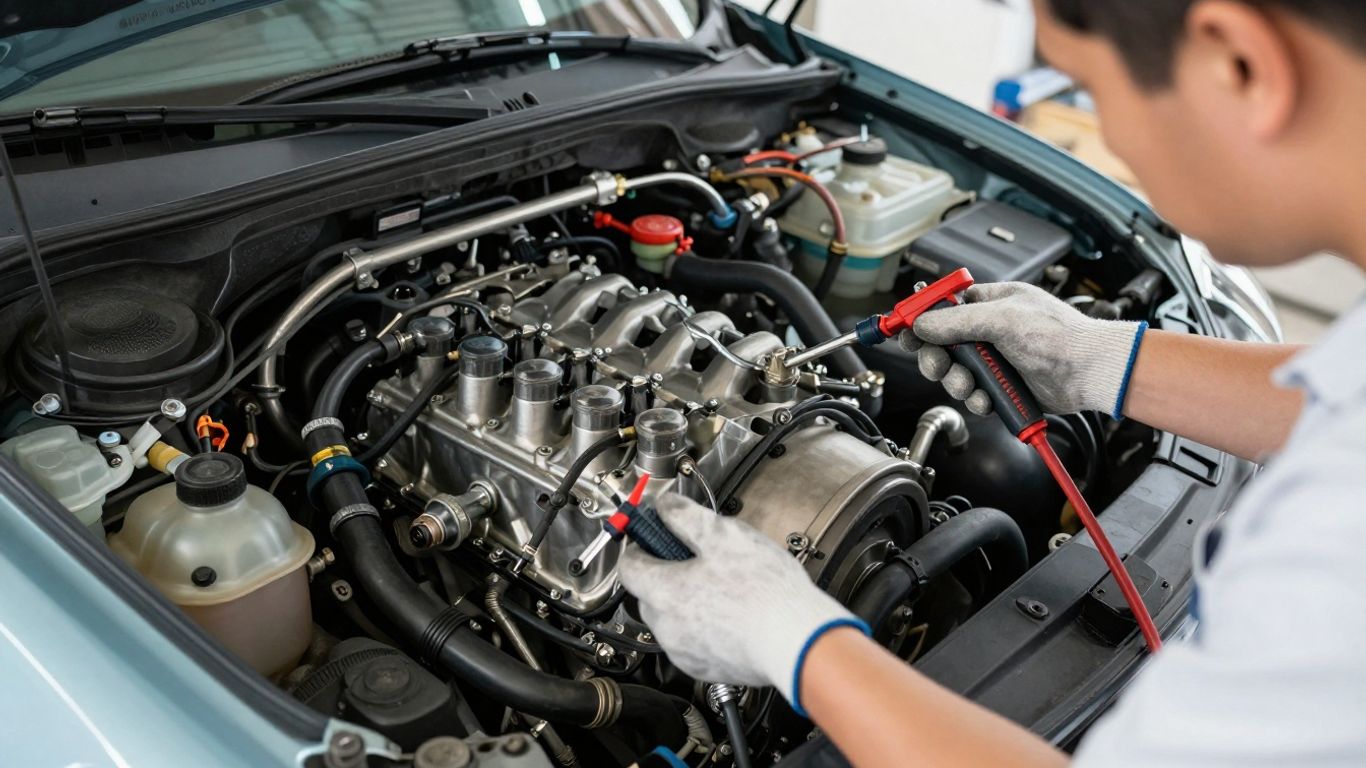
Inspecting coolant levels and visible leaks
With the engine cold and parked on level ground, check the expansion tank against its marked range. Note the fluid color and condition, then inspect around the pump, hoses, radiator, thermostat housing, and tank for wetness or dried deposits. Record whether the level drops over several cold checks rather than repeatedly filling without finding the cause.
Use the correct fluid and avoid touching spilled coolant, which is toxic to people and animals. A clean piece of cardboard beneath the vehicle can help show the location and timing of a drip.
Looking for pulley movement and belt problems
With the engine off, a technician can inspect belt tension, alignment, glazing, cracks, and fraying. Excessive movement or play at the pump pulley may indicate bearing wear, but pulley looseness can have other causes as well. The belt should never be grabbed or tested while the engine is operating.
A useful inspection separates belt noise from pump noise and checks neighboring pulleys at the same time. This is especially important when a belt replacement is being considered, because a misaligned pulley can damage a new belt.
Checking coolant circulation and temperature changes
A technician can monitor how the engine warms, compare hose temperatures, and observe whether coolant circulation develops as expected once the thermostat opens. Sudden temperature spikes, uneven heating, or a lack of flow can support a pump or thermostat diagnosis. These checks require care because hoses and coolant become hot and pressurized.
The pattern matters more than one touch test. Infrared measurement or suitable diagnostic equipment provides a safer, more repeatable comparison than placing a hand on engine parts.
Using pressure testing and diagnostic tools
A pressure test can reveal leaks that are difficult to see during a static inspection. Scan data can help compare the reported coolant temperature with an independent measurement, while belt and pulley inspection can identify mechanical causes. If combustion gases are suspected, a separate chemical test may be needed.
The following sequence keeps the investigation focused and reduces guesswork:
- Confirm the coolant level and visible condition with the engine cold.
- Inspect the pump area, hoses, radiator, tank, belt, and nearby pulleys.
- Check temperature behavior and circulation with appropriate equipment.
- Pressure-test the system when a leak is suspected.
- Test for combustion gases if coolant loss or bubbling remains unexplained.
These steps are not a substitute for repair training, but they show why a sound diagnosis looks beyond the pump itself. The ZP Automotive service description, for example, specifically discusses checking the entire cooling system after replacement, which is a sensible standard for confirming the repair.
Knowing when professional testing is necessary
Professional help is appropriate when the engine has overheated, coolant is rapidly escaping, the belt has failed, or the source of the leak is unclear. It is also the safer choice when access to the pump is restricted or the pump is driven by a timing belt. Continuing to dismantle parts without the correct timing and torque information can create a second failure.
Search results may also mix useful maintenance material with unrelated subjects, such as Genshin Impact, Dubai basement retaining walls, Maui wedding packages, Home Team Luxury Rentals, or Trivexa BR. Use vehicle-specific manuals and qualified technicians for the actual repair decision rather than assuming every result applies to an MG.
How urgent an MG water pump failure is
A suspected water pump failure should be treated as a cooling-system fault with the potential to become an engine fault. The urgency depends on the temperature reading, coolant loss, noise, and whether the engine has already overheated. When in doubt, stopping early is cheaper than testing how far the car can go.
Why driving with an overheating engine is risky
An overheating engine can warp or crack components, damage seals, and compromise the head gasket. Continued driving also increases the chance that coolant will be lost completely or that a belt-driven pump will stop operating altogether. The damage may continue even if the gauge briefly returns to normal after slowing down.
A warning light, rising gauge, steam, or loss of cabin heat should change the plan immediately. Stop before damage spreads is a better rule than trying to reach the next service station.
When to stop immediately and arrange recovery
Stop as soon as it is safe if the gauge reaches the red zone, steam appears, coolant is pouring out, or the engine begins running roughly with a strong coolant odor. Turn off the engine and keep away from the cap and hot components. Arrange recovery when the fault is clear, the coolant level cannot be maintained, or the belt has failed.
Do not restart repeatedly to see whether the symptom has disappeared. A short restart can turn a marginal cooling problem into a severe overheating event.
Short-term precautions before a repair
Park on level ground, allow the engine to cool fully, and check for obvious leaks without opening a pressurized system. Keep people and pets away from spilled coolant, and do not substitute plain water as a permanent solution. If a technician has advised adding the correct coolant for a brief move, follow that advice only when there is no active leak or overheating.
The safest short-term precaution is usually not driving at all. A tow protects the engine and avoids exposing you to a sudden loss of cooling on the road.
Warning signs of secondary engine damage
After an overheating event, watch for persistent coolant loss, white exhaust vapor, rough running, oil that looks milky, hard cooling-system hoses soon after a cold start, or repeated bubbling in the expansion tank. None of these signs alone proves head gasket damage, but together they justify further testing before normal use.
A repaired pump does not erase the effects of a previous overheat. Ask for the cause of the temperature rise and the condition of the engine to be documented, especially if the gauge entered the red zone.
Repairing and preventing future MG water pump failures
The repair should address both the failed component and whatever allowed the problem to develop. That may mean replacing the pump, renewing a belt or tensioner, correcting coolant contamination, or repairing a leak elsewhere. Afterward, the system needs to be filled, bled, and tested correctly for the specific MG model.
Choosing between water pump repair and replacement
In most cases, a complete replacement is preferred when the bearing, seal, impeller, or housing has failed. Some pumps are not designed for practical internal repair, and an apparently small seal issue can coexist with bearing wear. The technician should inspect the pump type, access requirements, and condition of related parts before recommending the work.
A replacement decision should be based on evidence rather than the symptom alone. If testing finds a thermostat, hose, fan, or sensor fault instead, repairing that component may resolve the overheating without replacing a healthy pump.
Replacing related belts, tensioners, and seals
If the pump shares a drive belt with other components, belt condition and replacement history matter. A worn tensioner, idler, seal, or misaligned pulley can damage the new pump or belt. Renewing accessible related parts during the same job may prevent duplicated labor, but only when the parts and service procedure support that choice.
The correct fasteners, torque settings, belt routing, and timing procedure must be followed. A belt that looks acceptable can still be unsuitable if it has been contaminated by coolant or oil.
Selecting the correct coolant for an MG
Use the coolant specification required for the exact engine and model year. Do not choose solely by color, and do not mix products unless the manufacturer or coolant documentation confirms compatibility. The system may also need the correct dilution, bleeding procedure, and protection level.
If the old fluid is rusty, oily, or full of particles, simply adding fresh coolant will not solve the underlying condition. The repairer should decide whether flushing is appropriate and whether another component is causing contamination.
Following recommended service intervals
Keep records of coolant changes, belt inspections, pump replacement, and any overheating events. Follow the MG service schedule for the specific vehicle, while adjusting attention when the car operates in heavy traffic, extreme heat, or dusty conditions. Regular checks make gradual coolant loss and belt deterioration easier to spot.
A service interval is not a guarantee that a part cannot fail early. New noise, a changing gauge, or a low expansion-tank level should be investigated even when the next scheduled service is months away.
Confirming the cooling system works after repair
After repair, the system should be filled with the correct coolant, air removed according to the vehicle procedure, and inspected for leaks. The technician should verify operating temperature, fan behavior, heater performance, belt tracking, and coolant level after a complete cool-down. A short road test followed by another inspection can reveal issues that are not visible when stationary.
Keep watching the level and gauge during the first few drives. A successful repair should restore stable temperature control without new noise, vapor, odor, or unexplained coolant loss.
Conclusion
Recognizing MG water pump failure signs early gives you the best chance of protecting the engine. Treat overheating, leaks, unusual pulley noise, steam, and sudden loss of cabin heat as reasons to stop and investigate, then confirm the diagnosis with safe testing rather than replacing parts blindly.
Frequently Asked Questions
What are the first signs of a failing water pump?
Early clues often include a small coolant leak, a new whining or grinding noise, a changing temperature gauge, or a cabin heater that suddenly produces less heat. One symptom is not conclusive, so look for a pattern.
Can a car have a bad water pump without leaking coolant?
Yes. A pump can suffer bearing, pulley, impeller, or circulation problems before an obvious external leak develops. Overheating or unusual noise may appear first.
Is it safe to drive with a water pump problem?
Driving is risky if the engine is overheating, coolant is escaping, steam is visible, or the belt has failed. Stop safely and arrange recovery rather than relying on short trips.
How can a water pump fault be confused with a thermostat fault?
Both can cause overheating or poor cabin heat. Pump noise, pulley play, and a leak near the pump support a pump diagnosis, while temperature behavior and coolant-flow testing help distinguish the two.
What coolant should be used after a water pump replacement?
Use the specification and mixture required for the exact vehicle. Coolant color is not a reliable compatibility guide, and products should not be mixed without confirmation.
Does replacing the water pump fix previous overheating damage?
It fixes the pump fault but cannot automatically reverse damage caused by earlier overheating. Continued coolant loss, rough running, white exhaust vapor, or bubbling may require engine-related testing.
How long does a water pump usually last?
Service life varies with the vehicle, pump design, coolant condition, belt system, mileage, and maintenance. Inspection history and current symptoms are more useful than relying on one universal lifespan.